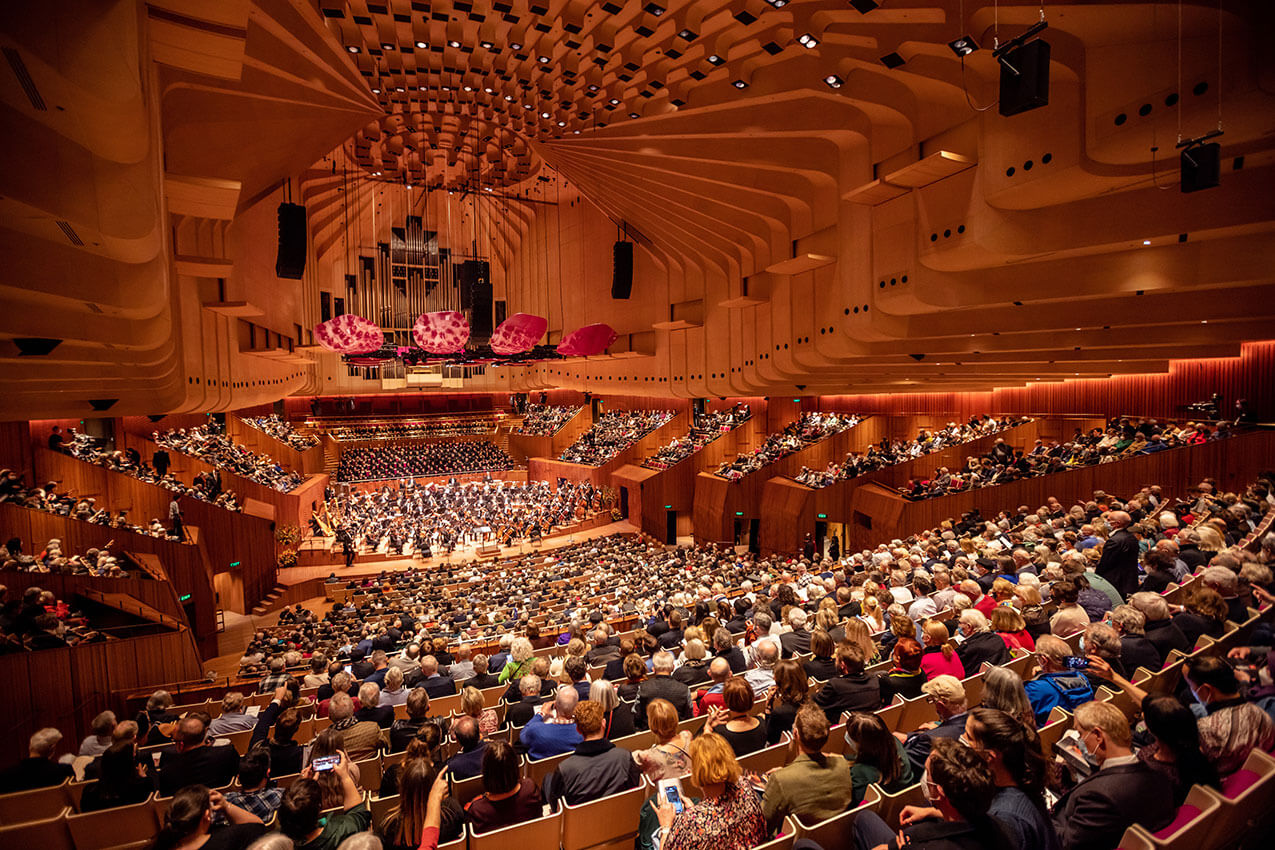
SYDNEY OPERA HOUSE
Jørn Utzon's billowing concrete sails on Bennelong Point, opened 1973. The renovated Concert Hall (reopened 2022) sounds as good as the roof looks, with birch-veneered acoustic petals tuning the room in real time.

MELBOURNE RECITAL CENTRE
ARM Architecture's 1,000-seat shoebox in Southbank, opened 2009. Plywood tree-bark interior, Arup-tuned acoustics. Cited by working soloists as the cleanest small-room sound in the southern hemisphere.

HAMER HALL (ARTS CENTRE MELBOURNE)
Roy Grounds' 1980s underground concert hall, redesigned 2012 by ARM as a sequence of cantilevered timber drums. 2,466 seats sunk three storeys below the Yarra floodplain. Melbourne Symphony Orchestra's home.

ADELAIDE FESTIVAL CENTRE
John Morphett's 1973 white-tetrahedron roof on the Torrens, the southern hemisphere's first multi-venue arts complex. Sister sculpture to Sydney's sails. Anchor of WOMADelaide each March.

PERTH CONCERT HALL (IWELAM)
Howlett & Bailey's 1973 brutalist temple in raw concrete and warm jarrah. Recently renamed Iwelam (Noongar for place of music). Houses the largest mechanical-action pipe organ in the southern hemisphere.

QPAC CONCERT HALL
Robin Gibson's 1985 modernist complex on the South Bank. 1,600-seat fan-shaped hall built around a 6,566-pipe Klais organ, the largest in Australia. The starry-night ceiling reflectors double as light sources.

CITY RECITAL HALL
1999 chamber shoebox tucked into Angel Place between two skyscrapers. The only purpose-built concert venue in Sydney since the Opera House. Australian Brandenburg Orchestra home.

WOMADELAIDE
Annual world-music festival in Botanic Park since 1992. Stages spread under 200-year-old Moreton Bay figs whose buttress roots make natural amphitheatres. Four days every March.

BLUESFEST BYRON BAY
Easter-weekend festival on the Tyagarah Tea Tree Farm, 11 km north of Byron Bay. Six big-top tents in rolling pasture, Pacific paddock-away. The medicinal-herb smell at dawn is part of the listening.

DARK MOFO (MONA HOBART)
Two-week midwinter festival at David Walsh's MONA museum, June each year. Subterranean Berriedale gallery becomes the engine room for ritualised noise, fire, and ceremonial swimming.

ULURU (ANANGU COUNTRY)
The world's largest monolith, sacred to the Anangu people who have sung this country for at least 30,000 years. The rock itself is the world's most patient acoustic instrument. Public ceremonies are rare; the silence is the programme.
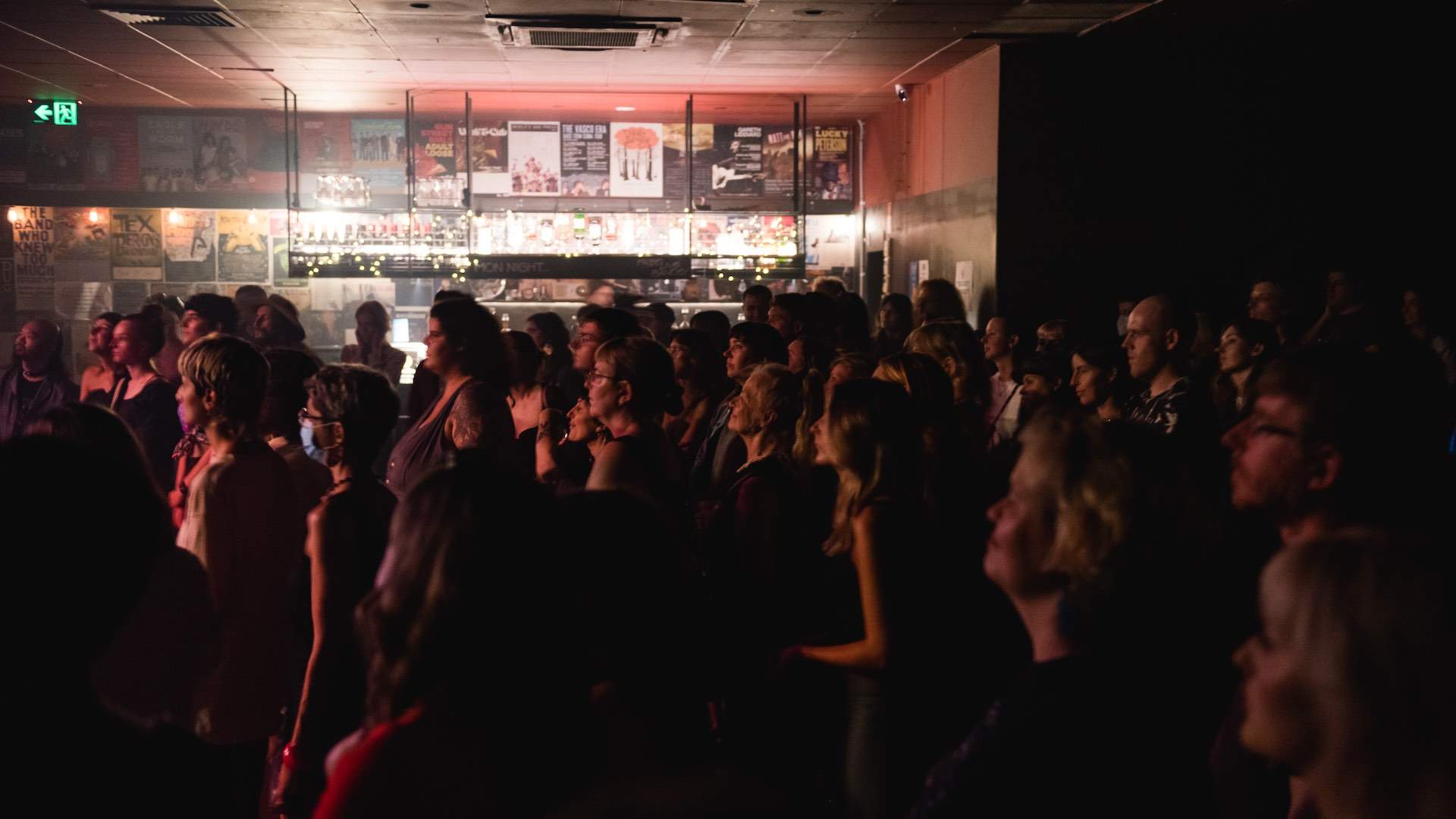
NORTHCOTE SOCIAL CLUB
250-cap pressed-tin-ceiling bandroom in the back of an 1854 hotel on High Street, Northcote. The prototypical Melbourne pub bandroom. Courtney Barnett, Big Thief, Phoebe Bridgers all played pre-arena.

KIRI TE KANAWA THEATRE (AOTEA CENTRE)
1990 postmodern complex on Aotea Square. The 2,139-seat Kiri Te Kanawa Theatre, renamed 2021 in honour of the Māori soprano, is the country's largest proscenium hall. Auckland Philharmonia Orchestra home.

MICHAEL FOWLER CENTRE
Sir Miles Warren's 1983 sculptural concrete drum on Civic Square. 2,209-seat tiered-fan auditorium, NZ Symphony Orchestra residency. The Cook Strait southerly is part of the experience at intermission.

CHRISTCHURCH TOWN HALL
Warren & Mahoney's 1972 modernist masterwork, restored NZ$167m and reopened 2019 after the 2011 earthquake. 2,494-seat in-the-round oval. The Harold Marshall ambiophonic acoustic prototype now used at Tokyo and Adelaide.

SPLORE FESTIVAL
Three-day boutique festival in February on Tāpapakanga Regional Park, a Hauraki Gulf beach 75 km east of Auckland. 8,000 attendees under ancient pōhutukawa trees. Programmed in partnership with Ngāti Whanaunga and Ngāti Pāoa iwi.

WOMAD AOTEAROA (BOWL OF BROOKLANDS)
Three-day world-music festival every March at the Bowl of Brooklands, a natural amphitheatre carved into native bush in Pukekura Park. Lake-facing main stage, audiences on grassy banks under fern groves.

TE MARAE O RONGOMARAEROA (TE PAPA)
Cliff Whiting's contemporary national marae inside Te Papa Tongarewa, the Museum of New Zealand. A wharenui that belongs to all iwi rather than one. Sunday afternoon kapa haka performances free and public.

CENTRE CULTUREL TJIBAOU
Renzo Piano's 1998 masterwork on the Tinu peninsula. Ten timber-and-steel huts up to 28 metres tall, ribbed like upturned Kanak ceremonial structures, tuned by the trade winds. Named for the assassinated Kanak independence leader Jean-Marie Tjibaou.

PLACE TO'ATĀ (HEIVA I TAHITI)
5,000-seat open-air amphitheatre on the Pape'ete waterfront. Heiva i Tahiti since 1881 runs three weeks of competitive 'ori Tahiti dance and hīmene singing every July with troupes of 100+ performers.

FEST'NAPUAN
Pacific's longest-running music festival since 1996. Four days every October at Saralana Park in central Port Vila. Free admission. The opening kastom (traditional) night is the most intimate.

WAIKIKI SHELL
Edwin Bauer's 1956 white concrete clamshell facing 2,400 seated and 6,000 on the lawn in Kapi'olani Park. Diamond Head behind the stage. Site of Hawaiian sovereignty concerts since the 1970s.

MERRIE MONARCH FESTIVAL
Most prestigious hula competition in the world. Annual since 1964 the week after Easter, in honour of King David Kalākaua. Hālau hula from Hawai'i, the US mainland, Japan and Aotearoa compete over four nights in Hilo.

BISHOP MUSEUM (HAWAIIAN HALL)
1889 Romanesque-revival hall built from local lava-stone. Three storeys of prized koa-wood display cases, a full-size sperm-whale skeleton suspended overhead. Kani ka pila slack-key sessions among the artefacts.

RAINBOW SERPENT FESTIVAL
Longest-running Australian transformational festival, since 1998. Four days annually in bush venue west of Melbourne, Victoria. Psytrance and electronic programming with strong art-installation and ceremonial elements.